

A fundamentally viable company can find itself unable to meet its obligations because of events entirely outside its control. War, disruption to supply chains, interruption of trade, delayed payments and sudden increases in operating costs can turn an otherwise healthy business into one facing an immediate liquidity crisis.
Following Cabinet Decision No. 94 of 2026, the emergency financial crisis provisions set out in Part Five of the Federal Decree-Law No. 51 of 2023 Promulgating the Financial and Bankruptcy Law (the “Law”) were activated in relation to preventive settlement, restructuring and bankruptcy proceedings with effect from 28 February 2026.
Under the emergency provisions, where a debtor applies for the initiation of preventive settlement or bankruptcy declaration proceedings, the court has discretion to accept the application without appointing a trustee, provided the debtor can prove that the instability in its financial position arose because of the emergency financial crisis.
The protection is therefore not simply available to every company experiencing financial difficulties during the relevant period. It will be necessary to demonstrate the effect of the emergency on its financial position through proper contemporaneous records.
Creating Time to Find a Solution
A debtor whose application is accepted may seek a period of up to 40 days to negotiate with creditors with a view to reaching an agreement to settle. Where agreement is achieved, the settlement period offered by the debtor may not exceed 12 months from the date of the Bankruptcy Court’s decision approving the debtor’s application.
Importantly, where creditors representing two-thirds of the value of the debt of those creditors who participate in the negotiation procedures approve the settlement, the agreement is binding on all creditors, including creditors who did not participate in the negotiations.
This provides a potentially powerful mechanism for achieving a collective restructuring rather than allowing individual creditor action to determine the future of the business.
Protection from Creditor Action
The emergency regime also provides protection against the initiation of bankruptcy proceedings by creditors in respect of qualifying debtors during the period in which the emergency financial crisis provisions apply.
A business obtaining protection should immediately address its underlying financial position, prepare reliable cash-flow forecasts, identify unnecessary expenditure, engage with key creditors and determine whether additional funding or operational restructuring is required.
If the business cannot reasonably become viable, restructuring should not be used simply to delay the consequences of insolvency. Where, however, the underlying enterprise remains sound and the problem is predominantly one of temporary liquidity, early restructuring can preserve considerable value.
Protection of Business Assets and Continuity
Article 254 provides that the Bankruptcy Court shall not take precautionary measures over assets necessary for the continuation of the debtor’s business during the emergency financial crisis, including affixing seals to the debtor’s business headquarters and assets.
Existing Proceedings and Extended Time Limits
Article 255 also provides flexibility in relation to proceedings that were admitted before the emergency financial crisis. Where an application for initiation of proceedings was submitted by the debtor or a creditor and admitted by the Bankruptcy Court before the emergency financial crisis, the Court may amend the deadlines and periods prescribed by the Law by granting additional periods of up to twice the ordinary statutory periods, where necessary to address the direct consequences of the emergency financial crisis on the debtor’s business.
The Importance of New Money
The emergency framework also contemplates the provision of new financing, including, subject to the Court’s approval, financing which may be obtained with or without security and which has priority over any existing ordinary debt owed by the debtor as at the date of the decision initiating proceedings.
Where an existing secured asset is used to secure the new financing, the ranking of the new security will generally be lower than the existing security, unless the relevant secured creditors agree to an equal or higher ranking.
This is particularly significant, without fresh funding an otherwise viable restructuring may fail simply because the business runs out of cash before the benefits of the restructuring can be realised.
Directors and Managers During the Emergency
The legislation provides particular protection concerning payments of ordinary wages and salaries, necessary for business continuity, but management must continue to act prudently, maintain appropriate accounting records and protect the interests and assets of the business.
Decisions taken during a period of financial distress should therefore be properly considered and documented.
The more difficult the company’s financial position becomes, the more important it is that directors can demonstrate that decisions were taken in good faith, on the basis of appropriate information and for legitimate commercial purposes.
What Should Banks Do?
When a customer encounters financial difficulty, the lender faces an important choice. Should the matter immediately move into recovery and enforcement, or is there a realistic prospect that early intervention could produce a better outcome?
The answer should depend upon the business, not merely upon the existence of a payment default.
A lender should seek to understand the cause of the distress, the underlying viability of the business, the quality of management, the company’s short-term cash requirements and the likely return under restructuring compared with enforcement or liquidation.
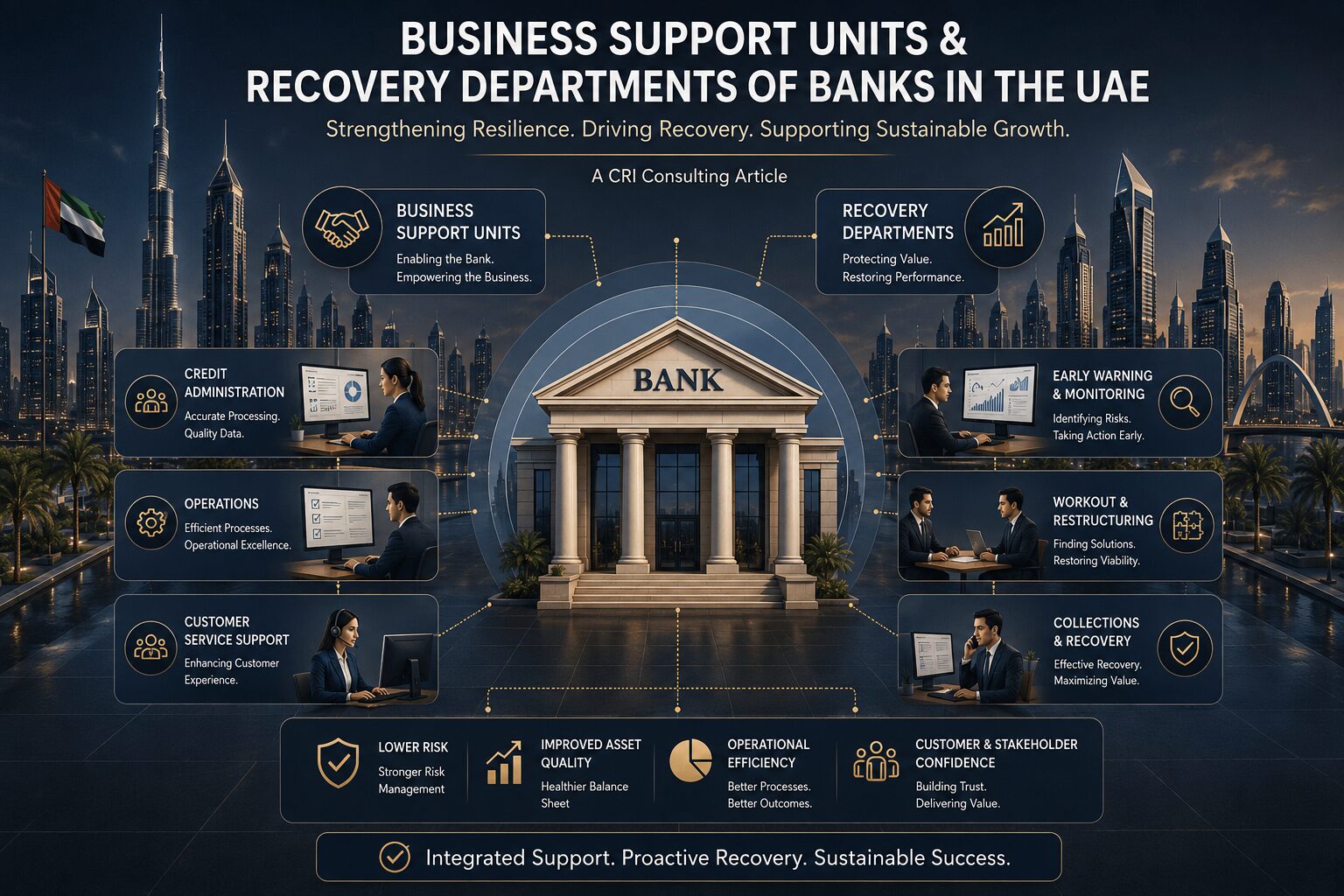
This is where a properly structured Business Support function can play an important role.
Business Support should not be confused with debt recovery. Its purpose is to identify problems early, engage constructively with borrowers and determine whether intervention can preserve the business and improve the lender’s ultimate recovery.
Modern restructuring practice increasingly recognises that the objective should not simply be to determine how the assets of a failed company are divided amongst creditors. Where possible, the first question should be whether failure can sensibly be avoided.
That does not mean protecting businesses which have no realistic prospect of survival. It means recognising that a viable enterprise can experience serious financial distress without having become an economically failed business.
For businesses affected by the present circumstances, the lesson is straightforward, do not wait until liquidity has disappeared before seeking advice and engaging with creditors. For lenders, the lesson is equally important, the earlier a viable but distressed borrower is identified, the greater the range of solutions available and the greater the opportunity to preserve value.
The difference between restructuring and recovery is very often timing, by the time recovery becomes the only option, the opportunity to rescue the business may already have been lost.
Chris is a Chartered Accountant, member of the Institute of Chartered Accountants in England and Wales (ICAEW) and the Emirates Association for Accountants and Auditors (EAAA), his details are on the list of approved Insolvency Practitioners in DIFC and ADGM. He is also a UK, Cyprus and Romania licensed Insolvency Practitioner.