
With 43 years’ experience in insolvency and restructuring across multiple jurisdictions, I have worked closely with financial institutions, company directors and other stakeholders in distressed situations. Throughout my career, I have seen first-hand the difference that dedicated Business Support Units within banks can make in preserving value, stabilising businesses and improving recovery outcomes.
It is from this experience that I share my views on why such units are not merely operational functions, but essential strategic tools in today’s evolving financial landscape.
For many financial institutions, a customer’s journey from relationship management to recoveries is viewed as a natural progression.
Once repayments are missed, financial covenants are breached or default becomes inevitable, responsibility shifts from supporting the customer to protecting the bank’s position and maximising recoveries.
By that stage, however, many of the options that could have preserved value have already disappeared.
The reality is that businesses rarely fail overnight. Financial distress is usually a gradual process, with warning signs emerging months or even years before a formal default occurs. Cash flow tightens, margins reduce, reporting becomes inconsistent and management begins making increasingly reactive decisions. These are often the moments when a bank has the greatest opportunity to influence the outcome.
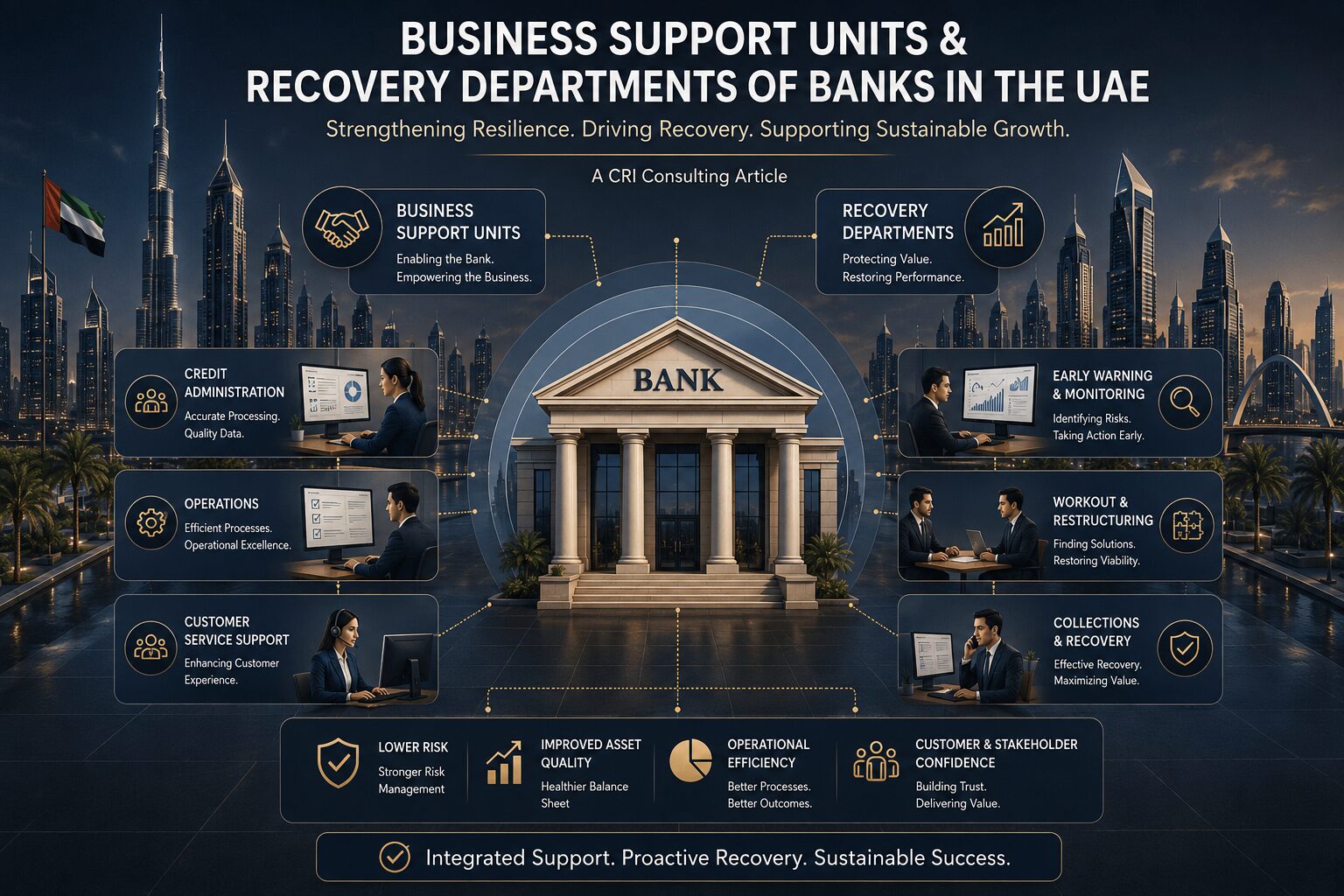
This is why many international financial institutions have invested in establishing dedicated Business Support or Special Assets teams that operate between mainstream relationship management and formal recoveries.
Their role is not simply to manage distressed loans. It is to identify problems early, assess whether a business remains viable and, where appropriate, work with both the customer and the bank to restore stability before recovery action becomes necessary.
Relationship managers are understandably focused on developing customer relationships, generating new business and supporting growth. Recovery departments, by contrast, are responsible for enforcing the bank’s rights and maximizing recoveries once a loan has failed. Between those two functions lies a critical period where many borrowers remain fundamentally viable but require closer monitoring, objective financial assessment and decisive intervention.
Its role is to understand the underlying causes of financial stress rather than simply reacting to the symptoms. Is the business suffering from temporary liquidity pressures, or are there deeper structural issues? Is management capable of implementing changes? Can the debt be restructured? Would additional working capital, revised repayment terms or operational improvements restore the business to financial health?
Every viable business that is successfully rehabilitated represents a loan that avoids the significant costs, uncertainty and management time associated with formal recovery actions. In many cases, preserving an operating business produces a better financial outcome than enforcing security after value has already deteriorated.
There are wider benefits as well. Businesses that survive continue to employ staff, support suppliers and contribute to the broader economy. While those outcomes are not the primary objective of a lender, they often align with achieving a stronger commercial result.
Early intervention also gives banks the opportunity to reassess their own position. Financial distress often exposes weaknesses that were not apparent when the original facility was approved. Security values may have changed, financial reporting may no longer be reliable, or covenant monitoring may have failed to identify deteriorating performance soon enough.
Business Support teams are well placed to coordinate independent business reviews, updated valuations, cash flow forecasting and restructuring assessments, and provide credit-decision makers with a realistic understanding of both the risks and the opportunities.
Perhaps more importantly, these teams bring a different perspective.
Recovery departments are understandably focused on enforcement and debt collection. Business Support professionals focus on preserving enterprise value wherever that remains commercially achievable. Those objectives are not mutually exclusive, but they require different conversations and a different mindset.
A constructive dialogue while a business remains capable of recovery is invariably more productive than negotiations commenced after liquidity has been exhausted and stakeholder confidence has deteriorated.
This is particularly relevant in today’s economic environment.
Businesses are operating against a backdrop of higher borrowing costs, inflationary pressures, supply chain disruption, geopolitical uncertainty and rapidly changing consumer behavior. Financial pressure is no longer limited to poorly managed companies. Well-run businesses with sound fundamentals can also experience periods of genuine financial stress.
Banks therefore need processes that recognise the difference between temporary financial pressure and irreversible decline.
Not every borrower can be rescued, nor should every distressed exposure be restructured. In some cases, recovery action is both necessary and commercially appropriate. The challenge is identifying which option offers the best outcome before events dictate the decision.
Independent advisers also have an important role to play. Objective financial reviews, viability assessments and restructuring advice provide Business Support teams with the information needed to determine whether a borrower should be rehabilitated, restructured or transferred to recoveries. Early access to independent expertise enables decisions to be made on evidence rather than assumption.
Ultimately, a bank’s success should not be measured solely by how much it recovers after a loan has failed. It should also be measured by how many viable businesses never reach that point.
Chris is a Chartered Accountant, member of the Institute of Chartered Accountants in England and Wales (ICAEW) and the Emirates Association for Accountants and Auditors (EAAA), his details are on the list of approved Insolvency Practitioners in DIFC and ADGM. He is also a UK, Cyprus and Romania licensed Insolvency Practitioner.